
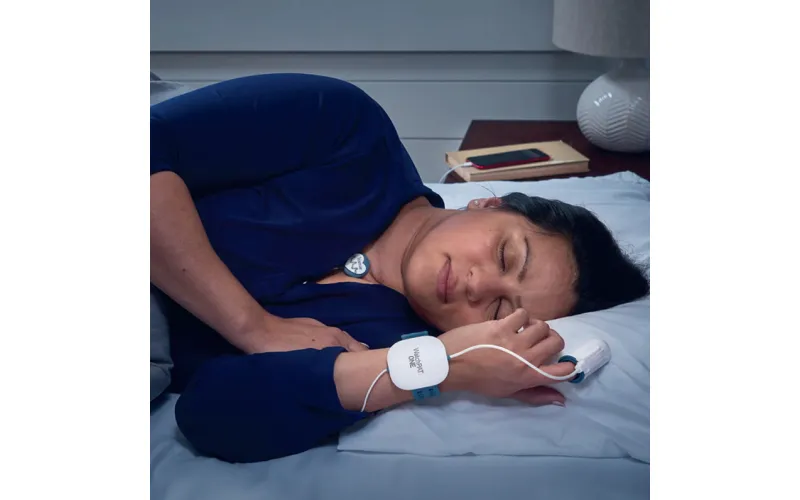
At home sleep apnea tests (HSAT) offer a convenient and cost-effective way to detect moderate to severe obstructive sleep apnea at home. These portable devices monitor breathing, oxygen levels, and body position but don’t track brain activity or actual sleep stages. Research, including a 2022 study by Zancanella et al., shows that HSAT results closely match lab-based polysomnography for key measures like total sleep time and efficiency. However, since HSAT relies on total recording time rather than true sleep time, it might underestimate apnea severity occasionally. Device errors or improper use can also affect accuracy. Overall, HSAT is reliable for selected patients but should be followed by lab testing if results are unclear or symptoms persist.
What Are At-Home Sleep Apnea Tests and How Do They Work?
At home sleep apnea test (HSAT) are portable devices designed to monitor key breathing-related signals while you sleep in your own bed. These devices track breathing patterns, oxygen levels, respiratory effort, and body position using sensors placed on areas like the chest, finger, or nasal passages. Unlike in-lab sleep studies, HSAT does not measure brainwaves or neurological signals, so it cannot capture true sleep stages or the detailed structure of sleep. Typically, a doctor orders the test, and after instructions from a healthcare provider or sleep technician, patients set up the device themselves before going to sleep. The device records episodes of apnea, which are pauses in breathing, and hypopnea, which refers to shallow breathing. Because the test is done at home, it often reflects more natural sleep patterns compared to a lab setting. After the test, a sleep specialist reviews the data to determine if obstructive sleep apnea is present and how severe it might be. These smaller, less intrusive devices offer a convenient alternative to lab studies, allowing many people to get diagnosed without an overnight hospital stay.

How Do At-Home Tests Compare to In-Lab Sleep Studies?
In-lab polysomnography (PSG) remains the gold standard for diagnosing sleep apnea because it records a wide range of physiological signals, including brain waves, eye movements, muscle activity, heart rate, breathing patterns, and oxygen levels. This comprehensive data allows clinicians to accurately determine sleep stages and events. At-home sleep apnea tests (HSAT), on the other hand, focus mainly on breathing patterns, oxygen saturation, respiratory effort, and body position. They do not measure brain activity, which means they estimate apnea events over the total recording time rather than actual sleep time. Despite this, a 2022 study showed that sleep efficiency, total sleep time, and sleep latency measured by the same equipment at home and in the lab were not significantly different. However, home tests did report slightly longer wake times after sleep onset and delayed REM sleep onset, likely due to user-related factors such as sensor placement or device handling. HSAT devices generally correlate well with in-lab PSG for moderate to severe obstructive sleep apnea, often achieving accuracy rates above 90%. Meta-analyses support a strong correlation (around 0.82) between apnea-hypopnea index (AHI) scores from HSAT and PSG, although sensitivity and specificity can vary based on patient population and device type. It is important to note that HSAT is less effective at detecting mild cases or more complex sleep disorders, where in-lab PSG provides more detailed insight. The convenience and accessibility of home testing make it a practical option for patients with a high likelihood of moderate to severe OSA who do not have other complicating health issues. When HSAT results are unclear or symptoms persist despite a negative home test, follow-up with a full in-lab PSG is usually recommended to ensure accurate diagnosis and appropriate treatment.
Common Limitations and Errors in Home Sleep Apnea Testing
Home sleep apnea tests (HSAT) have useful advantages but come with some notable limitations that can affect their accuracy. One key issue is that HSAT devices do not measure sleep stages since they lack brainwave monitoring. This means the apnea-hypopnea index (AHI) is calculated based on total recording time rather than actual sleep time, which can underestimate the severity of sleep apnea, especially if the patient spends a lot of time awake during the test. Sensors used in HSAT can also become loose or fall off during the night, causing gaps or inaccuracies in the data collected. This is more likely without professional supervision, as patients must set up the sensors themselves, which sometimes leads to incorrect placement or device operation errors like not starting the recording properly. Certain patient groups, such as those with heart failure, neuromuscular diseases, or complex sleep disorders, are not ideal candidates for HSAT because these conditions may complicate or mask apnea events, making at-home testing less reliable. False negatives are a concern, particularly in mild cases of obstructive sleep apnea or when apnea events do not follow typical patterns, which can result in missed diagnoses. Environmental factors at home, such as noise, interruptions, or uncomfortable sleeping conditions, may also interfere with sleep quality and the accuracy of the test. Additionally, some HSAT devices face technical limitations or occasional sensor malfunctions that can reduce data quality. Because HSAT does not track brain activity, AHI values from these tests may differ from those obtained through in-lab polysomnography (PSG), potentially influencing diagnosis and treatment decisions. For these reasons, interpreting HSAT results requires careful clinical judgment, considering the possibility of underestimating the condition or missing certain events, and should be supported by follow-up testing when necessary.
Benefits of Using At-Home Sleep Apnea Tests
At-home sleep apnea tests offer several advantages that make them an attractive option for many patients. One of the biggest benefits is convenience: patients can sleep in their own beds, which often leads to a more natural sleep pattern compared to the artificial environment of a sleep lab. This can result in data that better reflects typical breathing behaviors during sleep. These tests are also much more cost-effective, typically costing only one-third to one-fifth of an in-lab polysomnography, making diagnosis more affordable and accessible. The simplicity of the devices means they are easier to obtain and use, which reduces wait times for diagnosis and allows treatment to begin sooner. Since home sleep apnea tests use fewer sensors and do not require an overnight stay in a clinical setting, patients usually find them more comfortable. This comfort can improve adherence and the likelihood of completing the test properly. Home testing is especially valuable for people living far from specialized sleep centers or those with mobility challenges, expanding access to care. Insurance often covers these tests for patients who meet clinical criteria, helping reduce financial barriers. The straightforward setup also saves time for both patients and healthcare providers. Additionally, at-home tests can be repeated on multiple nights if necessary, which may help detect apnea events that do not occur every night. By using home testing first, healthcare systems can prioritize in-lab studies for patients with more complex conditions, improving resource allocation. Overall, these factors contribute to higher diagnosis rates of obstructive sleep apnea by reaching patients who might otherwise go untested.
Who Should Use At-Home Testing and When to See a Doctor?
Home sleep apnea testing (HSAT) is best suited for adults who exhibit clear signs of moderate to severe obstructive sleep apnea, especially if they have risk factors like obesity, loud snoring, daytime sleepiness, or witnessed pauses in breathing during sleep. These symptoms suggest a high likelihood of sleep apnea, making HSAT a practical first step. However, if you have other health issues such as heart failure, neuromuscular diseases, or suspected complex sleep disorders, an in-lab sleep study is usually recommended instead, as HSAT may not capture the full picture in these cases.
Before using an at-home test, it’s important to consult with your doctor to ensure it’s the right option based on your symptoms and health history. After testing, follow-up discussions with your healthcare provider are crucial to interpret the results properly and decide on next steps. If your HSAT results come back normal but you still have symptoms, or if your symptoms worsen at any point, you should see your doctor promptly. They may recommend a more detailed evaluation in a sleep lab to get a comprehensive assessment.
Some patients might face challenges using the HSAT device correctly or may have inconclusive test data. In those situations, contacting a healthcare professional is important to avoid missed diagnoses. Additionally, doctors can help determine if multiple nights of testing or further evaluations are necessary, especially when symptoms are mild or unclear. Remember, HSAT results should never be used alone for treatment decisions without professional review and guidance.
Tips to Improve Accuracy of Your At-Home Sleep Apnea Test
To get the most accurate results from your at-home sleep apnea test, it’s important to follow the setup instructions carefully. Proper placement and secure attachment of sensors ensure reliable data collection throughout the night. Starting the device correctly before you fall asleep is crucial to avoid missing any early sleep events. Sleeping on your back or side is recommended since apnea events tend to occur more frequently in these positions, helping to capture a more representative sample of your breathing patterns. Avoiding alcohol, sedatives, or other substances that can alter your breathing on the test night also supports accurate readings. Creating a quiet, dark environment encourages natural sleep, reducing disturbances that might interfere with the test. Make sure your device is fully charged or prepared to prevent power interruptions that could lead to incomplete data. If possible, lightly check sensor attachments during the night without fully waking yourself, and ensure nasal cannulas or airflow sensors remain unobstructed or kink-free. It’s helpful to note any unusual events or difficulties you experience and share these with your healthcare provider, as they can affect interpretation. Finally, don’t hesitate to reach out to your doctor or technician if you have any questions about using the device before or after the test, as proper guidance can improve both comfort and accuracy.
- Follow the setup instructions carefully to ensure all sensors are placed correctly and securely.
- Start the device properly before going to sleep to avoid missing the beginning of the recording.
- Sleep on your back or side, as apnea events are often more frequent in the supine position and this helps capture events accurately.
- Avoid alcohol, sedatives, or other substances that can alter breathing patterns on the night of the test.
- Keep the environment quiet and dark to promote natural sleep during the test night.
- Charge or prepare the device fully before use to prevent interruptions due to low battery.
- Double-check sensor attachments during the night if possible, without disrupting sleep too much.
- Make sure nasal cannulas or airflow sensors are not kinked or blocked.
- Record any unusual events or difficulties you experience during the night to inform your healthcare provider.
- Contact your doctor or technician if you have questions about using the device before or after the test.
Summary of Accuracy Rates from Recent Studies
At-home sleep apnea tests (HSAT) generally show accuracy rates between 80% and over 90% for detecting moderate to severe obstructive sleep apnea (OSA). Sensitivity and specificity can vary widely depending on the type of device used, the patient population, and study design. For example, studies find a weighted average correlation of about 0.82 between the apnea-hypopnea index (AHI) measured by HSAT and in-lab polysomnography (PSG), the gold standard for diagnosis. HSAT tends to work best in patients with clear clinical signs of moderate to severe OSA, while accuracy decreases in mild cases or those with atypical symptoms or other health conditions. False negatives and false positives do occur but are less frequent when patients are carefully selected. Some meta-analyses report overall HSAT accuracy ranging from around 61% to over 90%, reflecting differences in testing protocols and devices. Home tests often slightly underestimate OSA severity because they do not measure sleep stages and can be affected by sensor dislodgment or technical issues. Using more advanced type 2 devices, which record multiple physiological signals similar to lab PSG, improves accuracy compared to simpler models. Overall, research supports HSAT as a useful diagnostic tool when combined with proper patient selection and clinical interpretation, offering a practical approach to identifying most patients with clinically significant sleep apnea.
Frequently Asked Questions
1. How reliable is an at home sleep apnea test compared to a clinical sleep study?
At home sleep apnea tests are fairly reliable for detecting moderate to severe sleep apnea, but they may miss milder cases or other sleep disorders that a clinical sleep study would catch. They provide a good initial screening but aren’t as comprehensive as lab tests.
2. Can the accuracy of an at home sleep apnea test be affected by user error?
Yes, user error can impact the accuracy since you have to correctly apply sensors and follow instructions. Improper placement of equipment or not wearing the device overnight as instructed can lead to incomplete or inaccurate results.
3. Do at home sleep apnea tests measure all types of sleep apnea accurately?
At home tests mostly focus on obstructive sleep apnea and might not detect central sleep apnea or complex cases as well. Clinical studies include brain activity monitoring which helps diagnose these other types more precisely.
4. How do factors like sleeping environment or position affect the test’s accuracy?
Your sleep environment and position can influence results. At home tests record your typical sleep setting, which can be a benefit, but if you move a lot or don’t wear the device properly, accuracy can drop. Some positions may worsen or mask apnea events.
5. What are common limitations that might lower the accuracy of at home sleep apnea testing?
Limitations include not capturing full sleep stages, lack of professional monitoring during the test, and the device’s inability to detect other issues like restless leg syndrome. These factors can make at home tests less detailed than clinical polysomnography.
TL;DR At-home sleep apnea tests use portable devices to monitor breathing and oxygen levels during sleep. They are generally accurate for detecting moderate to severe obstructive sleep apnea, with accuracy rates often over 90%, but they don’t measure sleep stages like in-lab studies. Limitations include possible sensor errors and less reliability in mild or complex cases. These tests offer convenience, lower cost, and better accessibility, making them suitable for many patients with a high likelihood of sleep apnea. Proper use and following instructions can improve accuracy, but a doctor’s evaluation and follow-up testing remain important when results are unclear or symptoms persist.

Seth Hatfield, a maverick in the realm of writing, seamlessly weaves tales from the world of construction and beyond. With a unique blend of insight and creativity, he invites readers on a journey through his diverse repertoire of articles.