
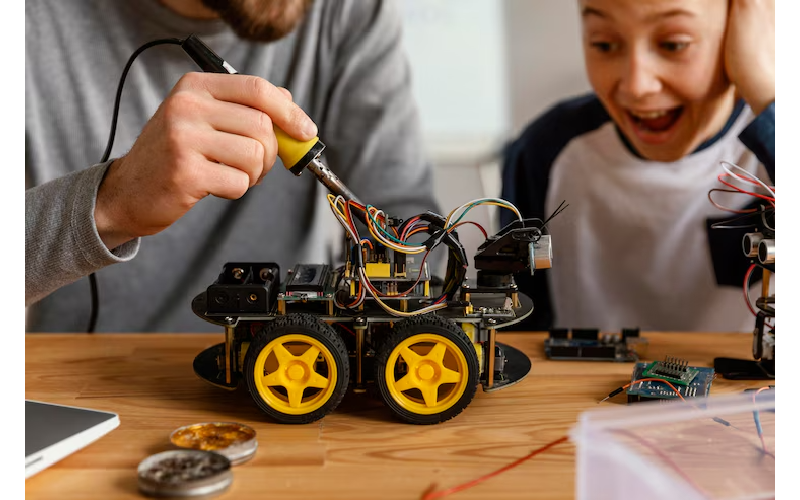
A typical mechanical engineering kit comes with a variety of core components like gears in different sizes (60, 40, and 20 tooth spur gears), levers about 20 centimeters long, and large pulleys including fixed and hanging triple pulley blocks. Along with these, you’ll find supporting hardware such as quick-attach gear hubs, spacers, universal spring hangers, and tripod stands to build stable setups. For measuring force and doing experiments on work and friction, metal spring scales and weights come included too. Everything is neatly stored in a Gratnells® tray for easy organization. Some kits even add electronics or hand tools depending on the learning level.
Core Mechanical Components in the Kit
The core mechanical components in a typical mechanical engineering kit focus on fundamental elements used to build and explore simple machines. This includes various spur gears in multiple sizes, two 60-tooth, two 40-tooth, and three 20-tooth gears, that enable hands-on study of gear ratios and torque transfer. Alongside gears, the kit features two 20 cm levers designed to help users experiment with the three classes of levers and understand mechanical advantage. Large pulleys with a 20 cm diameter provide a base for pulley system experiments, supported by fixed and hanging triple pulley blocks that demonstrate differences in mechanical advantage and load distribution. Right-angle connectors equipped with pulleys allow for more complex pulley arrangements and directional force changes, expanding the range of mechanical setups possible. The kit’s parts, including basic structural elements like shafts and axles, are made from durable materials suitable for repeated assembly and disassembly, which encourages experimentation. Their standardized dimensions ensure compatibility with other educational kits or expansions, making it easier to build gear trains, lever systems, and pulley setups. This hands-on approach allows learners to physically manipulate components and directly observe mechanical principles, providing a tangible understanding of foundational engineering concepts.

Supporting Hardware and Connectors Included
The kit includes a variety of supporting hardware and connectors that make mechanical experiments easier and more precise. Quick-attach gear hubs allow for fast mounting and swapping of gears, which is helpful when testing different gear ratios without wasting time on complex setups. Gear spacers keep rotating parts properly aligned, reducing friction and wear for smoother motion. Universal spring hangers securely hold springs or weights, making force and motion studies more reliable. Tripod stands with crossrails provide stable support for suspended components like pulleys or scales, ensuring consistent positioning throughout experiments. A friction block is also included to demonstrate friction effects and help understand static equilibrium. The kit comes with assorted connectors such as brackets and clamps, which enable flexible linking of parts and allow users to explore various machine configurations. Precise hardware lets you adjust gear meshing and pulley alignment accurately, improving experiment validity. Durable fasteners ensure parts stay securely in place during repeated use. Many connectors are modular, so they can be repositioned or replaced quickly, supporting multiple setups and breakdowns during hands-on learning sessions. These features combine to create a versatile and user-friendly toolkit for exploring mechanical principles in a practical, hands-on way.
- Quick-attach gear hubs for easy mounting and rapid swapping of gears during experiments.
- Gear spacers to maintain proper alignment and spacing between rotating parts, reducing friction and wear.
- Universal spring hangers designed to hold springs or weights securely in force and motion studies.
- Tripod stands with crossrails to support suspended components like pulleys or scales, providing stability.
- Friction blocks to illustrate the effects of friction in mechanical systems and support static equilibrium lessons.
- Assorted connectors that enable linking different mechanical parts, such as brackets and clamps.
- Hardware that allows precise adjustments of gear meshing and pulley alignment for accurate experiments.
- Durable fasteners included for securing parts reliably during use.
- Modular connectors that can be repositioned or replaced to explore various machine configurations.
- Parts designed to facilitate quick setup and breakdown, supporting multiple experiment iterations.
Measurement Tools and Force Components
The Mechanical Engineering Kit includes precise measurement tools that are crucial for understanding forces in mechanical systems. Metal spring scales calibrated to 10 newtons allow students to measure force accurately during lever and pulley experiments. These scales make it possible to track tension, compression, and friction forces quantitatively rather than just by observation. Alongside the spring scales, the kit provides weights for applying known loads, helping to explore concepts like mechanical advantage, work, and power. Strings are also included to connect weights and pulleys smoothly, ensuring efficient force transmission during experiments. These components work together to enable direct measurements that demonstrate Newton’s laws and principles of equilibrium in a hands-on way. Designed for durability and repeated classroom use, the measurement tools maintain their calibration over time and integrate seamlessly with the kit’s core parts. This setup allows students to visually and numerically follow force changes, supporting experiments that reveal how forces interact within mechanical systems.
Storage Solutions for Parts Organization
The Mechanical Engineering Kit comes with a Gratnells® storage tray designed to keep all components neatly organized and easy to access. Its compartmentalized layout separates gears, hardware, and tools, preventing parts from getting lost or damaged. This portable tray makes it simple to carry the kit between classrooms or labs without mixing pieces, which helps maintain kit integrity. Made from durable materials, the tray withstands frequent handling over time, ensuring long-term usability. The design encourages systematic organization, reducing setup and cleanup times significantly. Its compact size fits well in typical classroom cabinets or shelves, and the layout offers clear visibility of all parts at a glance. This setup allows students and instructors to perform quick inventory checks before and after use, supporting efficient lesson preparation and experiments with minimal disruption.
Educational Experiments Enabled by the Kit
The mechanical engineering kit opens up a variety of hands-on experiments that demonstrate fundamental mechanical concepts. Users can explore the three classes of levers by building setups that highlight how the position of the fulcrum, effort, and load affect mechanical advantage. Pulley experiments allow comparison between fixed, movable, and compound pulleys, showing how different arrangements reduce the required input force. Gear ratio investigations are made possible with multiple sized gears, helping learners see how changing gear size impacts speed and torque in mechanical systems. Static equilibrium can be studied by balancing forces using friction blocks and spring scales, reinforcing the principles of force balance and stability. The kit also supports experiments on friction, allowing users to measure its effect on motion and mechanical efficiency. Through manipulating simple machines, students can calculate work and force, bridging theory with physical application. These experiments are well-suited for physics and engineering education, offering opportunities to build models that mimic real-world machinery and understand how force transfers through mechanical components. Activities are designed to foster comprehension of power, energy conservation, and the interplay between force and motion, with adaptability for different education levels, from basic introductions to more advanced engineering challenges.
Additional Items Found in Advanced Kits
Advanced mechanical engineering kits often go beyond basic components to include Arduino microprocessor boards, enabling users to combine electronics with mechanical parts for projects involving automation and control. These kits typically feature sensors like accelerometers and thermocouples, which collect data on motion and temperature, adding a layer of real-world measurement and feedback. Motors are common additions, demonstrating how electrical energy converts into mechanical motion, essential for robotics or mechatronics studies. To build more durable or complex models, fasteners such as nuts, screws, and rivets are included, along with bearings and shaft collars that help reduce friction and improve power transmission efficiency. Hand tools like screwdrivers, wrenches, hex keys, and pliers come with many kits to aid in assembly and maintenance, giving users a practical experience similar to professional engineering work. Some kits also integrate electronics modules and software interfaces, allowing for programming and data logging which support advanced experiments and robotics projects. Additional structural elements are provided to build larger or intricate assemblies, while expanded sensor arrays enable multidisciplinary experiments that blend mechanical engineering with electronics and computer science concepts.
Typical Uses and Learning Applications
Mechanical engineering kits are valuable tools for hands-on STEM learning, allowing students to explore mechanical principles through direct experimentation. By building models such as simple machines, vehicles, or robotic parts, learners can visualize abstract concepts like force, work, energy, and motion in a concrete way. These kits support education from middle school through university by offering scalable complexity, making them suitable for a wide range of skill levels. They encourage project-based learning, helping students develop problem-solving and engineering skills as they assemble and test various mechanical systems. Using components like gears, levers, and pulleys, students can investigate mechanical advantage, system efficiency, and the interplay between parts within a mechanism. This tactile approach facilitates a clearer understanding of physics fundamentals and static equilibrium, which can be difficult to grasp through theory alone. Mechanical engineering kits also integrate well into broader science and technology curricula, serving as a foundation for further studies in engineering, robotics, and applied sciences. For example, students might use spring scales and weights to measure forces in lever experiments, or explore gear ratios to understand torque transmission, making the learning experience both practical and engaging.
Frequently Asked Questions
1. What basic components are usually included in a mechanical engineering kit box?
A mechanical engineering kit typically contains gears, pulleys, screws, nuts, metal or plastic frames, tools like screwdrivers or wrenches, motors, and instruction manuals. These help you build different mechanical models and understand basic engineering principles.
2. Are electronic parts such as motors and batteries commonly part of these kits?
Yes, many mechanical engineering kits come with small motors and battery holders. These parts let you add movement to your models, making the projects more interactive and closer to real mechanical systems.
3. How detailed are the instructions provided inside the box for assembling the models?
The instructions are generally detailed enough for beginners and intermediate users. They include step-by-step guides with diagrams or pictures to make assembling easier and to explain the function of each part in the build.
4. Do mechanical engineering kits include parts to create custom designs, or are they limited to specific models?
Most kits include a mix of standard parts that allow you to build the included models and also experiment with your own designs. The flexibility depends on the kit’s complexity and the number of components provided.
5. Is any software or digital support typically provided along with the physical components?
Some advanced kits offer software or apps that provide additional guides, 3D model previews, or animation of the mechanical movements. However, this is not standard for all kits and usually found in higher-end versions.
TL;DR A mechanical engineering kit typically includes gears, levers, pulleys, and supporting hardware like gear hubs and spring hangers. It also has measurement tools such as spring scales and weights, all organized in a storage tray. These kits support experiments on levers, pulleys, gear ratios, friction, and mechanical advantage, making them useful for learning physics and engineering concepts. Advanced kits may add electronics, fasteners, bearings, and hand tools for mechatronics or robotics projects. Designed for STEM education, they offer hands-on experience from middle school to university levels.

Seth Hatfield, a maverick in the realm of writing, seamlessly weaves tales from the world of construction and beyond. With a unique blend of insight and creativity, he invites readers on a journey through his diverse repertoire of articles.